
«ΕΥΡΩΠΑΪΚΟΙ ΔΡΟΜΟΙ ΤΟΥ ΝΙΚΟΥ ΚΑΖΑΝΤΖΑΚΗ»
 Διαβάστε το καταστατικό του σωματείου «ΕΥΡΩΠΑΪΚΟΙ ΔΡΟΜΟΙ ΤΟΥ ΝΙΚΟΥ ΚΑΖΑΝΤΖΑΚΗ»
Αρχαιρεσίες για ανάδειξη Διοικητικού Συμβουλίου του σωματείου ΕΥΡΩΠΑΪΚΟΙ ΔΡΟΜΟΙ ΤΟΥ ΝΙΚΟΥ ΚΑΖΑΝΤΖΑΚΗ
Την Κυριακή 17 Μαΐου 2026 πραγματοποιήθηκε Γενική Συνέλευση (Γ.Σ.) των μελών του νέου σωματείου ΕΥΡΩΠΑΪΚΟΙ ΔΡΟΜΟΙ ΤΟΥ ΝΙΚΟΥ ΚΑΖΑΝΤΖΑΚΗ στη διάρκεια της οποίας έγιναν αρχαιρεσίες για την ανάδειξη Διοικητικού Συμβουλίου (Δ.Σ.)
και Ελεγκτικής Επιτροπής (Ε.Ε.). Η Γ.Σ. έλαβε χώρα υβριδικά στο Γραφείο της Διεθνούς Εταιρείας Φίλων Νίκου Καζαντζάκη (ΔΕΦΝΚ), Πλατεία Κορνάρου 35, Ηράκλειο Κρήτης (2ος όροφος), στο οποίο θα στεγάζονται στο εξής οι ΕΥΡΩΠΑΪΚΟΙ ΔΡΟΜΟΙ ΤΟΥ ΝΙΚΟΥ ΚΑΖΑΝΤΖΑΚΗ, κατόπιν απόφασης του Διοικητικού Συμβουλίου της ΔΕΦΝΚ. Την Δευτέρα 18 Μαΐου, μετά από πρόσκληση έγινε συγκρότηση σε σώμα του Δ.Σ. και της Ε.Ε. που έχει ως ακολούθως :
Διοικητικό Συμβούλιο (9μελές)
Πρόεδρος: Στασινάκης Γεώργιος (Ελβετία)
Αντιπρόεδρος και Εκτελεστική Διευθύντρια : Αικατερίνη Ζωγραφιστού (Ελλάδα)
Γενική Γραμματέας: Σοφία Νταλαμπέκη (Ελλάδα)
Ταμίας: Εμμανουήλ Ζαχαριουδάκης (Ελλάδα)
Μέλη
Ανδρέας Μεταξάς (Ελλάδα), Υπεύθυνος Δημοσίων Σχέσεων σε Ευρώπη και Ελλάδα.
Μαρία Ζαχαριάκη (Ελλάδα), Ειδική Γραμματέας.
Georg Miltiades Gstrein (Αυστρία), Υπεύθυνος Τύπου, Επικοινωνίας και δράσεων σε Κεντρική και Ανατολική Ευρώπη.
Νικόλαος Παπαροϊδάμης (Γαλλία), Υπεύθυνος Παιδείας, Έρευνας και δράσεων στη Δυτική Ευρώπη.
Liza Karimyan (Αρμενία), Υπεύθυνη δράσεων στις χώρες του Καυκάσου (Γεωργία, Αρμενία, Αζερμπαϊτζάν).
Αναπληρωματικά μέλη:
Edith-Adriana Uncu (Ρουμανία) και Αθανάσιος Καλαμάτας (Ελλάδα). Το Δ.Σ. όρισε την Edith-Adriana Uncu υπεύθυνη για τις δράσεις στα Βαλκάνια και τον Αθανάσιο Καλαμάτα υπεύθυνο για θέματα Παιδείας στην Ελλάδα.
Στη θέση της Επιστημονικής Συμβούλου ορίστηκε η ομότιμη καθηγήτρια του Πανεπιστημίου Πελοποννήσου κ. Ιωάννα Σπηλιοπούλου.
Ονομάστηκε, επίσης, ο Γεώργιος Μαγκλής (Βέλγιο) Ειδικός Σύμβουλος σε οικονομικά και πολιτιστικά θέματα που αφορούν τις Διαδρομές.
Ελεγκτική Επιτροπή
Πρόεδρος: Σπύρος Ντζουροπάνος (Ελλάδα)
Μέλη : Ηλιάνα Ζιώγα (Ελλάδα) και Rivera Castillo Mauro (Ισπανία)
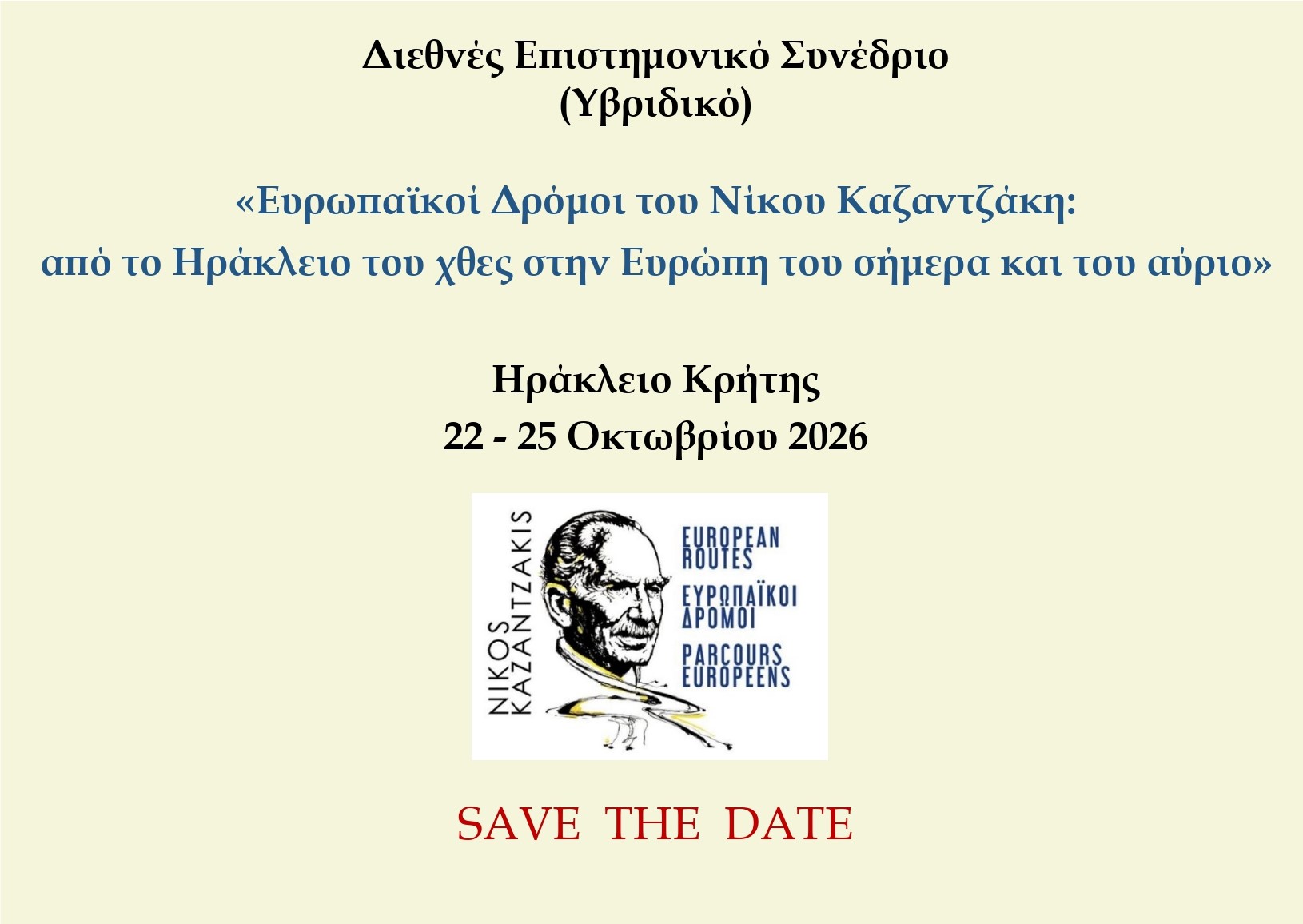
ΠΡΟΣΚΛΗΣΗ ΥΠΟΒΟΛΗΣ ΑΝΑΚΟΙΝΩΣΕΩΝ
Διεθνές Επιστημονικό Συνέδριο
Ηράκλειο, Κρήτης
22-25 Οκτωβρίου 2026
Ευρωπαϊκοί Δρόμοι του Νίκου Καζαντζάκη:
από το Ηράκλειο του χθες στην Ευρώπη του σήμερα και του αύριο
Οι Ευρωπαϊκοί Δρόμοι του Νίκου Καζαντζάκη, στο πλαίσιο των εργασιών ένταξής τους στις Πολιτιστικές Διαδρομές του Συμβουλίου της Ευρώπης με την υποστήριξη της Περιφέρειας Κρήτης, της Διεθνούς Εταιρείας Φίλων Νίκου Καζαντζάκη (ΔΕΦΝΚ), και του Μουσείου Νίκου Καζαντζάκη (Μυρτιά Ηρακλείου) προσκαλούν ερευνητές, πανεπιστημιακούς, επιστήμονες και μελετητές να συμμετάσχουν στο διεθνές επιστημονικό συνέδριο με θέμα «Ευρωπαϊκοί Δρόμοι του Νίκου Καζαντζάκη: από το Ηράκλειο του χθες στην Ευρώπη του σήμερα και του αύριο», διερευνώντας πτυχές της ευρωπαϊκής διάστασης της σκέψης του Κρητικού στοχαστή και συγγραφέα και επιχειρώντας αναγνωστικές προσεγγίσεις του έργου του με σύγχρονα ερμηνευτικά εργαλεία.
Σε συνάφεια με τις προτεραιότητες του Προγράμματος Πολιτιστικών Διαδρομών του Συμβουλίου της Ευρώπης, το συνέδριο στοχεύει στην ευρωπαϊκή και διεπιστημονική προσέγγιση του καζαντζακικού έργου και στην ανάδειξη της διαχρονικότητάς του σε σχέση με ζητήματα πολιτιστικής ταυτότητας, ελευθερίας, ετερότητας, βιωσιμότητας και καινοτομίας.
Θεματικοί άξονες του Συνεδρίου
1. Η παγκόσμια απήχηση του έργου ενός κατεξοχήν Ευρωπαίου διανοητή.
• Η έννοια της Ευρώπης ως πνευματικού και πολιτισμικού χώρου στον οποίο γαλουχήθηκε ο Νίκος Καζαντζάκης.
• Διαπολιτισμικοί διάλογοι και επιρροές. Απόπειρες επαναχαρτογράφησης του καζαντζακικού έργου.
• Τα ταξίδια του Καζαντζάκη ως αποτύπωμα του ευρωπαϊκού, φιλοσοφικού και ιστορικού περιβάλλοντος της εποχής του.
2. Ελευθερία, δικαιώματα και ανθρώπινη κατάσταση. Οι έννοιες της ελευθερίας και της υπαρξιακής ευθύνης στο καζαντζακικό έργο.
• Οι έννοιες της ελευθερίας και των ανθρωπίνων δικαιωμάτων στο έργο του Κρητικού συγγραφέα.
• Το άτομο απέναντι στην εξουσία και τις ιδεολογίες· η περίπτωση του Νίκου Καζαντζάκη.
• Ηθική, αμφισβήτηση και ευθύνη του ενεργού πολίτη, όπως διατυπώνονται στο καζαντζακικό έργο.
• Πολιτισμική δημοκρατία. Το παράδειγμα της Διεθνούς Εταιρείας Φίλων Νίκου Καζαντζάκη (ΔΕΦΝΚ).
3. Ετερότητα, ταυτότητα και συμπερίληψη. Το έργο του Καζαντζάκη υπό το πρίσμα της σύγχρονης κριτικής.
• Έμφυλες αναπαραστάσεις και σύγχρονες αναγνώσεις στο έργο του.
• Πολιτισμική, πνευματική και κοινωνική ετερότητα στο καζαντζακικό μυθιστόρημα.
• Ο «Άλλος» και οι απόπειρες ενσωμάτωσής του στην καζαντζακική σκέψη.
4. Επιστήμη, νεωτερικότητα και σύγχρονες πολιτισμικές προσεγγίσεις.
• Σχέσεις επιστήμης, φιλοσοφίας και μεταφυσικής στο έργο του.
• Ο Καζαντζάκης και η νεωτερικότητα.
• Διεθνές συγκείμενο και νέες μεθοδολογίες πρόσληψης του καζαντζακικού corpus.
5. Οι «Ευρωπαϊκοί Δρόμοι του Νίκου Καζαντζάκη» και η δυναμική της Πολιτιστικής Διαδρομής ως σύγχρονου εργαλείου πολιτιστικής ανάπτυξης: Μια νέα προοπτική.
• Οι «Ευρωπαϊκοί Δρόμοι του Νίκου Καζαντζάκη» και η σύνδεσή τους με τη
βιώσιμη ανάπτυξη.
• Ανάδειξη πολιτισμικής κληρονομιάς και διακρατική συνεργασία.
• Η αξία του διαλόγου μεταξύ της Ευρωπαϊκής Διαδρομής του Νίκου Καζαντζάκη και των άλλων Πολιτιστικών Διαδρομών.
• Οι «Ευρωπαϊκοί Δρόμοι του Νίκου Καζαντζάκη» ως πλατφόρμα εκπαίδευσης, διαλόγου και πολιτισμικής ανταλλαγής.
• Οι «Ευρωπαϊκοί Δρόμοι του Νίκου Καζαντζάκη» ως μοχλός ανάπτυξης του λογοτεχνικού τουρισμού στην Ελλάδα και το εξωτερικό.
Στόχοι του Συνεδρίου
• Η ενίσχυση της επιστημονικής και πολιτιστικής βάσης των «Ευρωπαϊκών Δρόμων του Νίκου Καζαντζάκη» και η ανάδειξή τους ως μια δυναμική πλατφόρμα, η οποία συνδέει τη λογοτεχνία με τις σύγχρονες ευρωπαϊκές αξίες και προκλήσεις.
• Οι ερμηνευτικές προσεγγίσεις των έργων του Νίκου Καζαντζάκη υπό το πρίσμα των σύγχρονων προκλήσεων που αντιμετωπίζει η Ευρώπη.
• Η ανάδειξη της διαχρονικής αξίας του καζαντζακικού στοχασμού.
Οδηγίες υποβολής
• Οι περιλήψεις (έως 300 λέξεις) θα πρέπει να περιλαμβάνουν σαφή αναφορά στον θεματικό άξονα. Ιδιαίτερα ενθαρρύνονται διεπιστημονικές προσεγγίσεις. Οι περιλήψεις και οι ανακοινώσεις μπορούν να υποβληθούν στην ελληνική, την αγγλική ή τη γαλλική γλώσσα.
• Καταληκτική ημερομηνία υποβολής περιλήψεων: 10 Ιουλίου 2026.
• Ενημέρωση για αποδοχή προτεινόμενων ανακοινώσεων: 10 Αυγούστου 2026.
• Καταληκτική ημερομηνία υποβολής πλήρους κειμένου εισηγήσεων (έως 3000 λέξεις) για την έκδοση των πρακτικών: 30 Σεπτεμβρίου 2026 (επισυνάπτονται οδηγίες συγγραφής).
• Οι ανακοινώσεις θα είναι διάρκειας 10-15 λεπτών.
• Αποστολή προτάσεων στο: european.routes.nikos.kazantzakis@gmail.com Το Συνέδριο θα πραγματοποιηθεί σε υβριδική μορφή με δυνατότητα εξ αποστάσεως παρακολούθησης και παρουσίασης των ανακοινώσεων.
Εκ μέρους της Επιστημονικής και της Οργανωτικής Επιτροπής
Δρ Αικατερίνη Ζωγραφιστού, Πρόεδρος της Διεθνούς Εταιρείας Φίλων Νίκου Καζαντζάκη (ΔΕΦΝΚ). Διδάκτορας Νεοελληνικής Φιλολογίας, Paul Valéry University Montpellier ΙΙΙ, France.
Δρ Έλενα Αβραμίδου, Εκτελεστική Διευθύντρια του Ελληνικού Κέντρου Σινολογίας (Hellenic Sinology Center – HSC) του Ιονίου Πανεπιστημίου, μέλος της Διοικούσας Επιτροπής της Έδρας UNESCO στο Ιόνιο Πανεπιστήμιο και του ΔΣ της Διεθνούς Εταιρείας Φίλων Νίκου Καζαντζάκη (ΔΕΦΝΚ).
ΠΡΟΣΚΛΗΣΗ ΥΠΟΒΟΛΗΣ ΑΝΑΚΟΙΝΩΣΕΩΝ
«PARCOURS EUROPEENS DE NIKOS KAZANTZAKI»

Élections pour la désignation du Conseil d’Administration de l’association « PARCOURS EUROPÉENS DE NIKOS KAZANTZAKI »
Le dimanche 17 mai 2026 s’est tenue l’Assemblée Générale (A.G.) des membres de la nouvelle association « PARCOURS EUROPÉENS DE NIKOS KAZANTZAKI », au cours de laquelle ont eu lieu les élections pour la désignation du Conseil d’Administration (C.A.) et
de la Commission de Contrôle.
L’Assemblée Générale s’est déroulée sous forme hybride dans les bureaux de la Société Internationale des Amis de Nikos Kazantzaki (SIANK), situés Place Kornarou 35, Héraklion, Crète (2e étage), où seront désormais hébergés les « PARCOURS EUROPÉENS DE NIKOS
KAZANTZAKI », à la suite d’une décision du Conseil d’Administration de la SIANK.
Le lundi 18 mai, après convocation officielle, le Conseil d’Administration et la Commission de Contrôle nouvellement élus se sont constitués comme suit :
Conseil d’Administration (9 membres)
Président : Georgios Stassinakis (Suisse)
Vice-Présidente et Directrice Exécutive : Aikaterini Zografistou (Grèce)
Secrétaire Générale : Sofia Ntalampeki (Grèce)
Trésorier : Emmanuel Zacharioudakis (Grèce)
Membres
Andreas Metaxas (Grèce), Responsable des Relations Publiques en Europe et en Grèce.
Maria Zachariaki (Grèce), Secrétaire Spéciale.
Georg Miltiades Gstrein (Autriche), Responsable de la Presse, de la Communication et des activités en Europe centrale et orientale.
Nikolaos Paparoidamis (France), Responsable de l’Éducation, de la Recherche et des activités en Europe occidentale.
Liza Karimyan (Arménie), Responsable des activités dans les pays du Caucase (Géorgie, Arménie, Azerbaïdjan).
Membres suppléants :
Edith-Adriana Uncu (Roumanie) et Athanasios Kalamatas (Grèce).
Le Conseil d’Administration a nommé Edith-Adriana Uncu responsable des activités dans les Balkans et Athanasios Kalamatas responsable des questions éducatives en Grèce.
Mme Ioanna Spiliopoulou, professeure émérite de l’Université du Péloponnèse, a été nommée Conseillère Scientifique.
Georgios Magklis (Belgique) a également été nommé Conseiller Spécial pour les questions financières et culturelles concernant les Itinéraires.
Commission de Contrôle
Président :
Spyros Ntzouropanos (Grèce)
Membres :
Iliana Zioga (Grèce) et Rivera Castillo Mauro (Espagne)
COMMUNIQUÉ DE PRESSE (25/5/2026)
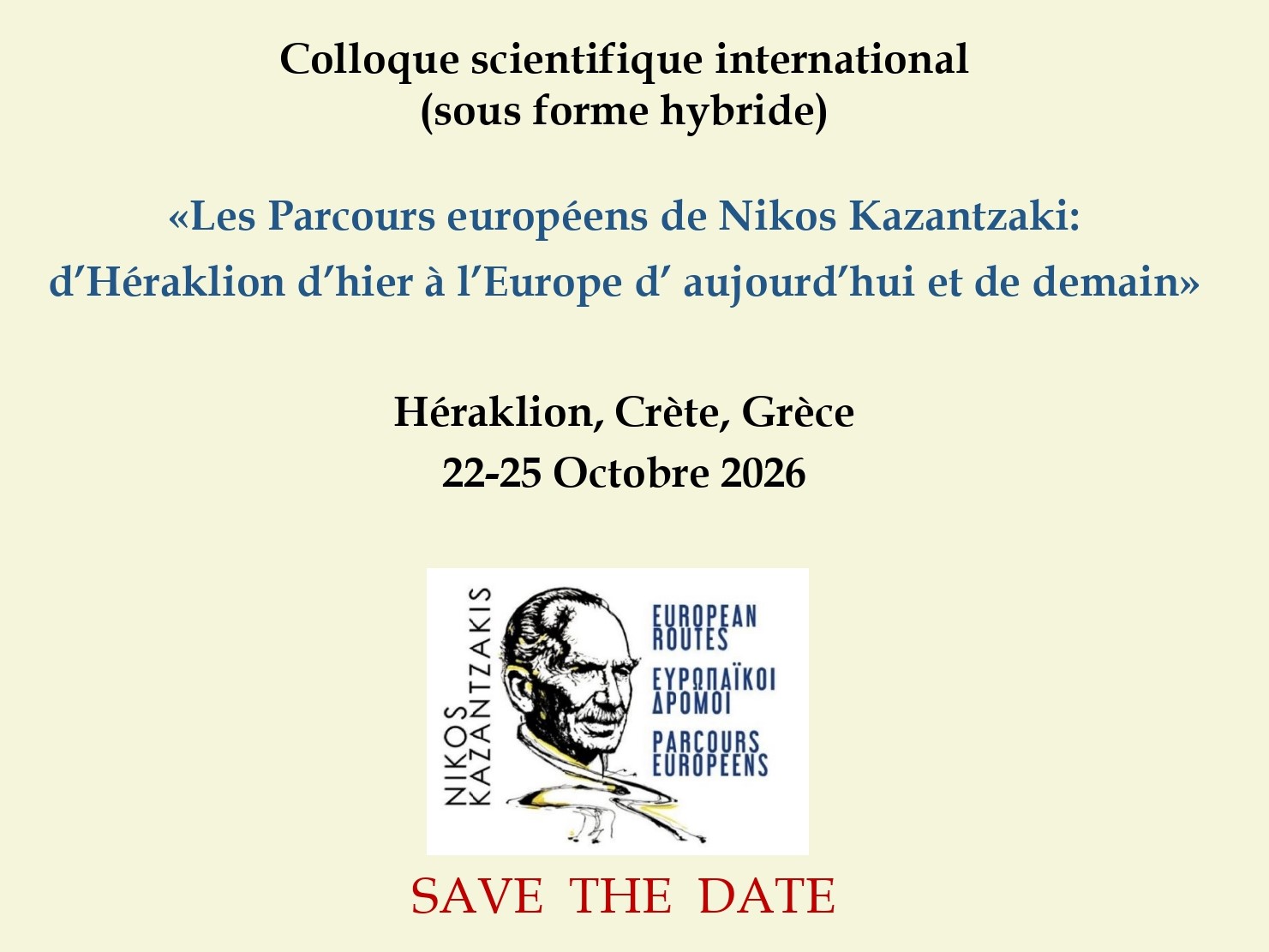
APPEL A DES PROPOSITIONS DE COMMUNICATIONS
Forum académique
Héraklion, Crète
22–25 octobre 2026
Les Parcours européens de Nikos Kazantzaki :
d’Héraklion d’hier à l’Europe d’aujourd’hui et de demain
Les « Parcours Européens de Nikos Kazantzaki », dans le cadre de leur démarche d’intégration au Programme des Itinéraires Culturels du Conseil de l’Europe, avec le soutien de la Région de Crète, de la Société Internationale des Amis de Nikos Kazantzaki (SIANK) et du Musée Kazantzaki (Myrtia, Héraklion) invitent chercheurs, universitaires, scientifiques et autres spécialistes à participer au colloque scientifique international intitulé : « Les Parcours européens de Nikos Kazantzaki : d’Héraklion d’hier à l’Europe d’ aujourd’hui et de demain».
Le colloque vise à explorer, à l’aide d’outils interprétatifs contemporains les dimensions européennes de l’œuvre et de la pensée de l’écrivain crétois, en proposant des approches critiques.
En rapport avec les priorités du Programme des Itinéraires Culturels du Conseil de l’Europe, le colloque ambitionne de promouvoir une approche européenne et interdisciplinaire de l’œuvre kazantzakienne, tout en mettant en lumière sa portée intemporelle à travers des thématiques telles que l’identité culturelle, la liberté, l’altérité, la durabilité et l’innovation.
Axes thématiques du colloque
1. Le rayonnement mondial de l’œuvre d’un intellectuel profondément européen
• L’Europe comme espace spirituel et culturel dans lequel Nikos Kazantzaki s’est formé.
• Dialogues interculturels et influences. Tentatives de relecture et de redéfinition de l’œuvre kazantzakienne.
• Les voyages de Kazantzaki envisagés comme le reflet des contextes européen, philosophique et historique de son époque.
2. Liberté, droits et condition humaine. Les notions de liberté et de responsabilité existentielle dans l’œuvre kazantzakienne.
• Les notions de liberté et de droits humains dans l’œuvre de l’écrivain Crétois.
• L’individu face au pouvoir et aux idéologies : le cas de Nikos Kazantzaki.
• Éthique, remise en question et responsabilité du citoyen engagé dans son œuvre.
• Démocratie culturelle : L’exemple de la Société Internationale des Amis de Nikos Kazantzaki (SIANK).
3. Altérité, identité et inclusivité. L’œuvre de Kazantzaki à l’aune de la critique contemporaine.
• Représentations homme-femme et lectures contemporaines de son œuvre.
• Altérité culturelle, spirituelle et sociale dans l’œuvre romanesque de Kazantzaki.
• « L’Autre » et les tentatives d’intégration dans la pensée kazantzakienne.
4. Science, modernité et approches culturelles contemporaines.
• Relations entre science, philosophie et métaphysique dans son œuvre.
• Kazantzaki et la modernité.
• Contexte international et nouvelles méthodologies d’analyse du corpus kazantzakien.
5. Les « Parcours Européennes de Nikos Kazantzaki » et la dynamique de l’Itinéraire culturel comme outil contemporain de politique culturelle et de développement : une nouvelle perspective.
• Lien avec le développement durable.
• Valorisation du patrimoine culturel et coopération transnationale.
• Dialogue entre l’Itinéraire de Kazantzaki et les autres Itinéraires culturels.
• Plateforme d’éducation, de dialogue et d’échanges culturels.
• Développement du tourisme littéraire en Grèce et dans le monde.
Objectifs du colloque
Renforcer et mettre en valeur la base scientifique et culturelle des « Parcours Européens de Nikos Kazantzaki » comme une plateforme dynamique reliant la littérature aux valeurs et enjeux européens contemporains.
• Proposer des lectures interprétatives de l’œuvre de Kazantzaki à la lumière des défis actuels de l’Europe.
• Mettre en valeur la pertinence intemporelle de sa pensée.
Modalités de candidatures
• Les résumés (300 mots maximum) doivent indiquer clairement l’axe thématique choisi. Les approches interdisciplinaires sont particulièrement encouragées.
• Les propositions peuvent être soumises en grec, en anglais ou en français.
Date limite des résumés : 10 juillet 2026.
• Notification d’acceptation : 10 août 2026.
• Date limite de présentation des textes complets (jusqu’à 3000 mots) pour publication des actes : 30 septembre 2026.
• Durée des communications : 10–15 minutes.
• Envoi des propositions à : european.routes.nikos.kazantzakis@gmail.com
Le colloque se tiendra en format hybride, avec possibilité de participation et de présentation des communications à distance.
Au nom du Comité scientifique et du Comité d’organisation
Dr Aikaterini Zografistou, Présidente de la Société internationale des Amis de Nikos Kazantzaki (SIANK). Docteure en littérature Université Paul Valéry-Montpellier III, France.
Dr Elena Avramidou, Directrice exécutive du Centre Hellénique de Sinologie (HSC) de l’Université Ionienne, membre du Comité directeur de la Chaire UNESCO à l’Université Ionienne et du Conseil d’administration de la SIANK.
APPEL A DES PROPOSITIONS DE COMMUNICATIONS
«EUROPEAN ROUTES OF NIKOS KAZANTZAKIS»

Elections for the Appointment of the Board of Directors of the Association “EUROPEAN ROUTES OF NIKOS KAZANTZAKIS”
On Sunday, May 17, 2026, a General Assembly (G.A.) of the members of the newly established association “EUROPEAN ROUTES OF NIKOS KAZANTZAKIS” was held, during which elections took place for the appointment of the Board of Directors (B.D.) and the Audit Committee (A.C.).
The General Assembly was conducted in a hybrid format at the offices of the International Society of Friends of Nikos Kazantzakis (ISFNK), located at 35 Kornarou Square, Heraklion, Crete (2nd floor). Following a decision of the ISFNK Board of Directors, the association
“EUROPEAN ROUTES OF NIKOS KAZANTZAKIS” will henceforth be headquartered at
these offices.
On Monday, May 18, following an official invitation, the newly elected Board of Directors and Audit Committee convened and were constituted as follows:
Board of Directors (9 members)
President:
Georgios Stassinakis (Switzerland)
Vice President and Executive Director:
Aikaterini Zografistou (Greece)
General Secretary:
Sofia Ntalampeki (Greece)
Treasurer:
Emmanuel Zacharioudakis (Greece)
Members:
Andreas Metaxas (Greece), Head of Public Relations in Europe and Greece.
Maria Zachariaki (Greece), Special Secretary.
Georg Miltiades Gstrein (Austria), Head of Press, Communications, and Activities in Central and Eastern Europe.
Nikolaos Paparoidamis (France), Head of Education, Research, and Activities in Western Europe.
Liza Karimyan (Armenia), Coordinator of Activities in the Caucasus countries (Georgia, Armenia, Azerbaijan).
Substitute Members:
Edith-Adriana Uncu (Romania) and Athanasios Kalamatas (Greece).
The Board of Directors appointed Edith-Adriana Uncu as Coordinator for Activities in the Balkans and Athanasios Kalamatas as Coordinator for Educational Affairs in Greece.
Professor Emerita Ioanna Spiliopoulou of the University of Peloponnese was appointed Scientific Advisor.
Georgios Magklis (Belgium) was also appointed Special Advisor on Financial and Cultural Matters concerning the Routes.
Audit Committee
President:
Spyros Ntzouropanos (Greece)
Members:
Iliana Zioga (Greece) and Rivera Castillo Mauro (Spain)
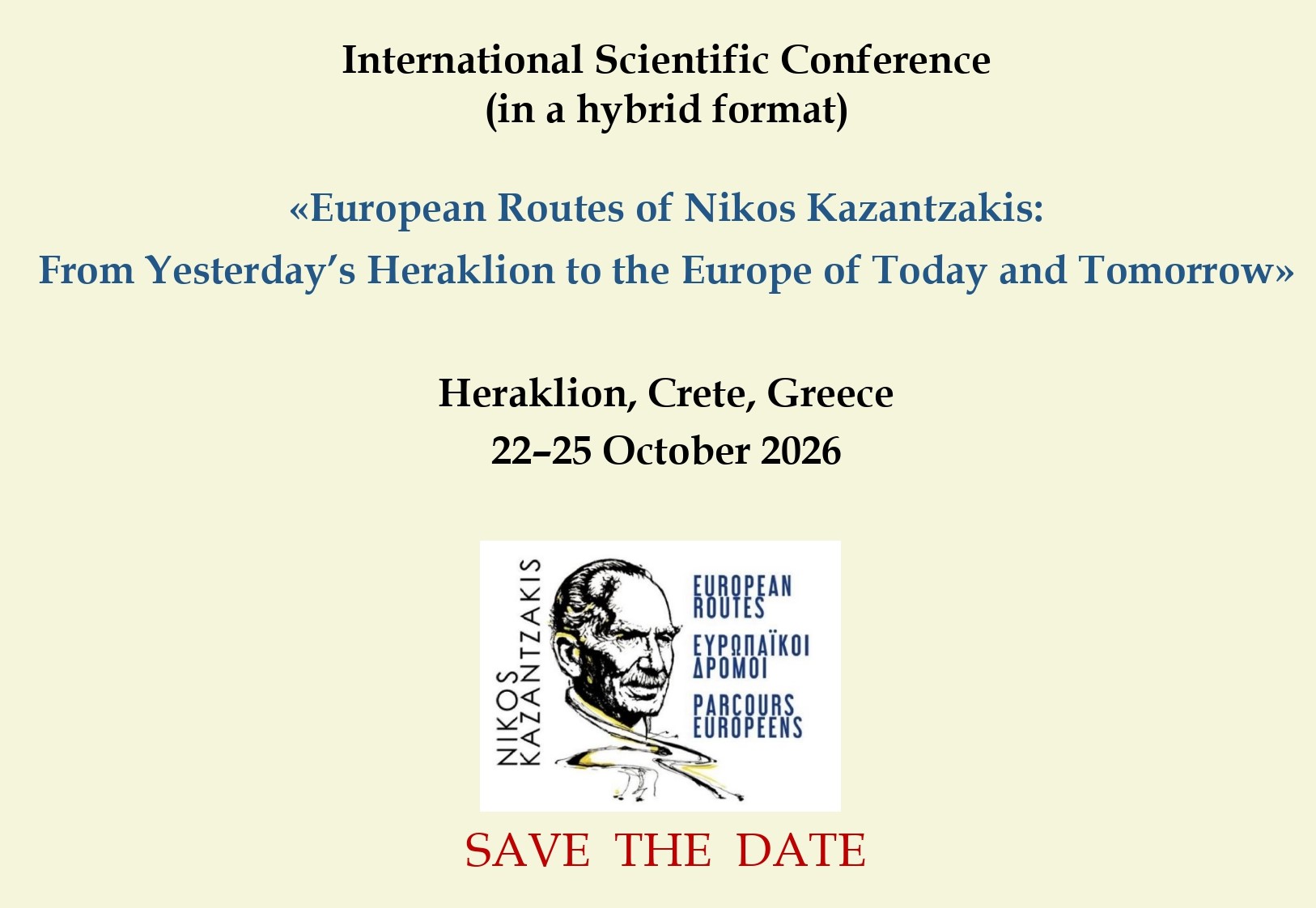
CALL FOR PAPERS
International Scientific Conference
Heraklion, Crete
October 2026, 22–25
European Routes of Nikos Kazantzakis: From Yesterday’s Heraklion to the Europe of Today and Tomorrow
The “European Routes of Nikos Kazantzakis”, as part of their ongoing effort to be included in the Cultural Routes of the Council of Europe, and with the support of the Region of Crete, the International Society of Friends of Nikos Kazantzakis (ISFNK) and the Nikos Kazantzakis Museum (Myrtia, Heraklion) invite researchers, academics, scholars, and experts to participate in the international scientific conference entitled: «European Routes of Nikos Kazantzakis: From Yesterday’s Heraklion to the Europe of Today and Tomorrow».
The conference seeks to explore the European dimension of the thought of the Cretan thinker and writer Nikos Kazantzakis, while fostering interpretative and critical approaches to his work through contemporary theoretical frameworks.
In line with the priorities of the Cultural Routes of the Council of Europe, the conference aims to promote a European and interdisciplinary perspective on Kazantzakis’ work and to highlight its enduring relevance to contemporary issues, including cultural identity, freedom, alterity, sustainability, and innovation.
Thematic Axes of the Conference
- The Global Impact of the Work of a Quintessential European Intellectual
- The notion of Europe as a spiritual and cultural space in which Nikos Kazantzakis was formed.
- Intercultural dialogues and influences: toward a re-mapping of Kazantzakis’ literary work.
- Kazantzakis’ journeys as reflections of the European philosophical and historical context of his time.
- Freedom, Rights, and the Human Condition: Concepts of Freedom and Existential Responsibility in Kazantzakis’ Work
- Conceptions of freedom and human rights in the work of the Cretan writer.
- The individual in confrontation with power and ideology: the case of Kazantzakis.
- Ethics, critical inquiry, and the responsibility of the engaged citizen as expressed in his work.
- Cultural democracy: the example of the International Society of Friends of Nikos Kazantzakis (ISFNK).
- Otherness, Identity, and Inclusion: Kazantzakis’ Work through the Lens of Contemporary Criticism
- Gender representations and contemporary readings of his work.
- Cultural, spiritual, and social alterity in the Kazantzakian novel.
- The concept of the “Other” and processes of integration within Kazantzakis’ thought.
- Science, Modernity, and Contemporary Cultural Approaches
- Interrelations between science, philosophy, and metaphysics in his work.
- Nikos Kazantzakis and modernity.
- The international context and new methodological approaches to the Kazantzakian corpus.
- The “Nikos Kazantzakis European Routes” and the Cultural Route as a Contemporary Tool for Cultural Policy and Development: New Perspectives
the potential of the Cultural Route as a contemporary tool for cultural development
- The “Nikos Kazantzakis European Routes” and their contribution to sustainable development.
- The promotion of cultural heritage and transnational cooperation.
- The value of dialogue between the Kazantzakis European Route and other Cultural Routes.
- The “Nikos Kazantzakis European Routes” as a platform for education, dialogue, and cultural exchange.
- The role of the “Nikos Kazantzakis European Routes” in fostering literary tourism in Greece and beyond.
Conference Objectives
- To strengthen the scientific and cultural foundation of the “Nikos Kazantzakis European Routes” and establish them as a dynamic platform connecting literature with contemporary European values and challenges.
- To promote interpretative approaches to the works of Nikos Kazantzakis in light of the pressing challenges facing Europe today.
- To highlight the enduring relevance of Kazantzakis’ intellectual legacy.
Submission Guidelines
- Abstracts (up to 300 words) should clearly indicate the relevant thematic axis. Interdisciplinary approaches are especially encouraged. Submissions may be made in Greek, English, or French.
- Deadline for abstract submission: 10 July 2026
- Notification of acceptance: 10 August 2026
- Deadline for full papers (up to 3,000 words) for publication in the conference proceedings: 30 September 2026 (writing guidelines attached).
- Presentations should be 10–15 minutes in duration.
- Proposals should be submitted to: european.routes.nikos.kazantzakis@gmail.com
The conference will be held in a hybrid format, enabling both in-person and remote participation and presentation of papers.
On behalf of the Scientific and Organizing Committees
Dr Aikaterini Zografistou, President of the International Society of Friends of Nikos Kazantzakis (ISFNK). PhD in Modern Greek Philology, Paul Valéry University- Montpellier III, France.
Dr Elena Avramidou, Member of the Board of Directors of the International Society of Friends of Nikos Kazantzakis (ISFNK). Executive Director of the Hellenic Sinology Center (HSC), Ionian University; member of the Sterring Committee of the UNESCO Chair at the Ionian University.
Πληροφορίες: